Interview with Keynote speaker: Mohammed Chahim
July 3, 2026
Day 2 → Nathalie Pettorelli & the first full day of sessions!
July 8, 2026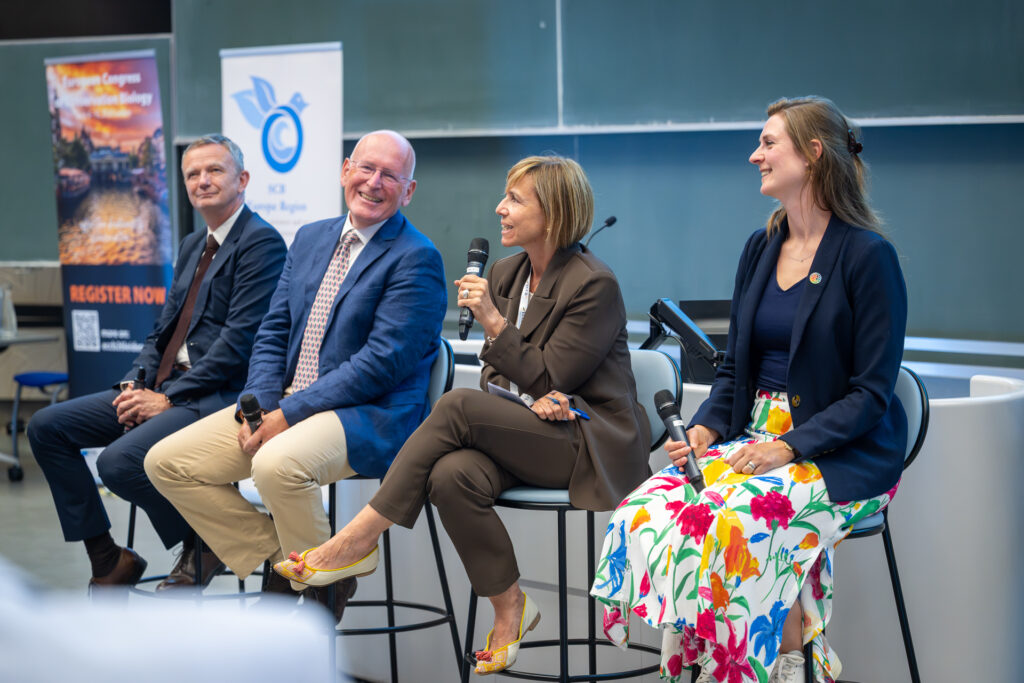
Sarah de Rijcke, Rector Magnificus of Leiden University, opened the ceremony by welcoming participants and introducing the university as the host of the 8th ECCB:
“Leiden University is committed to creating an inclusive and forward-looking environment for researchers by integrating sustainability into its partnerships, funding strategies, and campus design. From combining green infrastructure with water storage to using our campuses as living laboratories for biodiversity monitoring, we embed sustainability in how we operate. We also place strong value on collaboration, ensuring that education and research are accessible and shared with society. In this spirit, the European Congress of Conservation Biology brings together policymakers, practitioners, and students to advance effective biodiversity conservation. We are proud that Leiden University can serve as a platform for this important exchange.”
Laura Bosco followed by reminding us that ECCB is much more than a venue, program, or social activity.
“Scientists, policymakers, and students make up the space in which we are convening this week. At the 8th edition of ECCB, there is a bright and vibrant community in which we wish to continue building more opportunities to increase engagement and broaden perspectives and approaches to achieve greater impact in our collective work. The success of this congress lies in our ability to interact and open up to new ways to achieve effective conservation.”
Geert de Snoo engaged with this year’s theme: effective biodiversity conservation by exposing how theoretical and practical understandings often diverge, and called for a 1% GDP commitment globally.
“When we consider the goal of effective biodiversity conservation, we must look at both the strength of the science and the level of commitment from public institutions and stakeholders. The 8th ECCB represents scientific excellence; the challenge now is to mobilize the resources needed to turn knowledge into action. Currently, European countries spend around €142 billion on environmental protection, approximately one-third less than what experts recommend. Spending gaps in strategic areas are not new to Europe, and we are often reminded of it on the global stage. A clear and achievable benchmark would be a dedicated 1% EU spending target for biodiversity conservation—a small, beautiful number.”
The opening session brought together leading voices from policy, science, and research to reflect on the challenges and opportunities in advancing biodiversity conservation. Speakers emphasized the need for stronger connections between science, policy, and society to turn knowledge into action. Explore highlights from our speakers:
Frans Timmermans
“Recently, there has been growing concern that society is moving in the wrong direction when it comes to achieving effective biodiversity conservation. One of the greatest challenges we face is the disconnect between human health and biodiversity, despite the fact that healthy ecosystems are fundamental to a healthy society. Policymakers cannot solve this alone—they need the engagement and support of the public. Across Europe and beyond, there is enormous potential in people, and one of our most powerful tools is empathy. No machine can replace this uniquely human capacity. Protecting nature requires empathy, connection, and collective responsibility. We must trust that change is possible—that the pendulum can swing back in the right direction.”
Eric Mamer
“Policymakers are often required to make decisions under uncertainty, which underscores the critical importance of robust and reliable science. The true test of legislation lies not in what is written on paper, but in whether it delivers meaningful outcomes on the ground. Science is essential to making that possible. Europe depends on the engagement of the ECCB community, alongside experts from around the world. At the same time, scientists need a better understanding of how policy processes work, just as policymakers must better engage with science. Effective policy is grounded in strong science, and the most impactful research is that which anticipates the questions of tomorrow.”
Alessandra Zampieri
“The scientific community is the clear experts on conservation, they know the what and where of biodiversity loss. The Joint Research Council (JRC) provides the last step to achieving effective nature conservation by asking: How can you make sure that science is impactful? The JRC’s mandate is to provide evidence to support policymakers by ensuring a continuous dialogue, not a one-time input. Often, there is a call for more research, but biodiversity does not decline because of a lack of science, but because our economic model does not encompass nature. One needs to move from the idea that ‘nature is priceless’ to ‘nature is a measurable and a societal and economic asset.’ Biodiversity is a life support system and the key to the foundation of long-term competitiveness and resilience.”
Sanne Kruid
“There is the goal to live in harmony with nature by 2050. To achieve such a goal, there are incremental steps to getting there. More importantly, research gaps need to be filled, and coordination improved. This is not achievable solely by governments, but by collective action across all spheres of society. There is power in individuals, front-runners, and you, and in the power of communication: if we understand how to reach people better, then we will find unity in numbers.”
Stay tuned via our website and social media channels to get day-to-day updates!
